How International Art Collecting Is Changing

More informed, selective collectors who value their relationships with artists

The collectors described in The Art Basel and UBS Survey of Global Collecting 2026 show changing habits. The study, authored by Clare McAndrew for Arts Economics, draws on responses from 3,100 people across ten markets whose households have disposable financial assets exceeding one million dollars, excluding property and business assets.It offers insight into wealthy collectors, and its findings should not automatically be extended to the wider art audience.
The first finding concerns spending. Within the sample, average art purchases in 2025 reached $124,265, up 13% compared with 2024. Generation Z recorded an average of $347,460, significantly higher than previous generations. These figures require careful interpretation, however: in the first half of 2026, 77% of respondents spent less than $50,000 overall. High averages therefore coexist with a majority of buyers working with more modest budgets.

The development of taste retains a strong family influence. Some 28% identify their family as the source of their interest in collecting; among younger collectors, this figure rises to 40%. Visits to museums, galleries and art fairs are the second most common starting point, cited by 22%. The passing down of artworks is thus accompanied by the transmission of knowledge and habits: 72% of the sample report having inherited art.
Collectors are doing more research before buying. Some 72% carry out moderate or extensive research, compared with 62% in the 2025 survey; among Generation Z, the figure reaches 80%. Alongside expert advice, the use of digital tools is growing. Some 22% use apps or artificial intelligence tools as sources of advice, compared with 4% in 2024. The study reports predominantly positive views on AI’s contribution to discovering artworks and artists, although these opinions do not constitute evidence of its reliability.
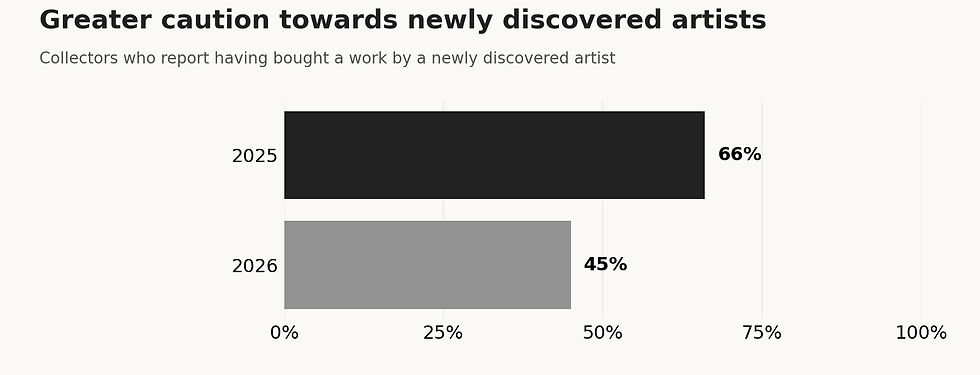
Greater knowledge, however, goes hand in hand with growing caution. The share of respondents who report buying works by newly discovered artists fell from 66% to 45% between the 2025 and 2026 surveys. Younger collectors remain more open: 56% of Generation Z bought a work by an artist previously unknown to them, compared with 36% of baby boomers. This is one of the report’s most significant findings: interest in discovery remains, but purchasing decisions require greater reassurance.
The ways collectors access the market are also changing. In 2025 and the first half of 2026, 87% bought from galleries and dealers, including purchases at art fairs. Some 62% bought at art fairs, which accounted for 15% of total art spending.Meanwhile, 69% bought directly from artists, through studio visits, commissions or Instagram. These channels overlap in collectors’ habits: direct contact and digital platforms sit alongside professional intermediation.
Painting retains its leading position, having been purchased by 76% of the sample and accounting for 31% of art spending. Works by women artists represent 44% of the artworks in collections, compared with 56% by male artists. Privacy is another factor: 64% prefer to keep their identity as art owners within their family or a small circle. Collecting and seeking public visibility, therefore, do not necessarily go hand in hand.
Above all, the report presents a picture of collectors seeking to make more informed choices. Their intentions remain favourable to expanding their collections: 39% plan to buy more art over the following twelve months, while 23% intend to sell. These are stated plans, rather than results already achieved. Amid generational change, digital tools and caution, a collecting audience continues to invest time and resources in art, seeking information and relationships that can support its decisions.


Comments